
Architect reference
This page lists runtime facts for Sero Architect. See Architect for the user guide.
Availability
Architect is the built-in @sero-ai/plugin-architect plugin. It has global
scope, so each profile has one project list. It requires persistent agent
sessions, the Orchestrator plugin, and the host capabilities
appAgent.invokeTool, tool.cli, appRuntime.background and
appRuntime.workspaceCreate.
SERO_ARCHITECT_MODEL names the owner's model as provider/model, with an
optional :thinking suffix. Without it, the owner uses the MED tier: the
project default when you set one, otherwise the global selection in Admin. A
tier never falls back to another provider. An unavailable model or an
unsupported thinking level is refused, and the reason is reported.
Terms
Phases and overlays
Phases, in order: intake, discovery, charter, build, release,
maintain. A project never moves back.
Overlays: decision, blocked, paused, limited. An overlay is derived on
every write from the record's flags and is never set by hand.
Milestone statuses
Verification states on a milestone: reported, verified, accepted,
delivered. A lower state never stands in for a higher one.
Wake sources
The runtime wakes the owner for these events, highest priority first:
One wake runs at a time. Wakes of the same kind merge. Ordinary work does not
wake the owner while the project is paused, limited, blocked or stopped.
Directives and decision responses can still wake it. Every wake ends with one
of sleep, decide or blocked; three turns in a row with no outcome
block the project.
Owner tool
The owner reaches the runtime through one bridged tool, architect, run as
sero architect --action <name> --projectId <id>. Every call carries the
project id and is refused for any session that is not that project's owner.
The owner session holds only the architect command and the platform tools.
The architect_projects management tool refuses an owner caller, so the owner
cannot approve its own charter, raise its own cap or answer its own decisions.
Management tool
The user's chat and the project page use architect_projects.
pause and stop do not cancel a running Workflow or Room. delete removes
the record and the owner session's grant; files in the folder stay.
Forced escalations
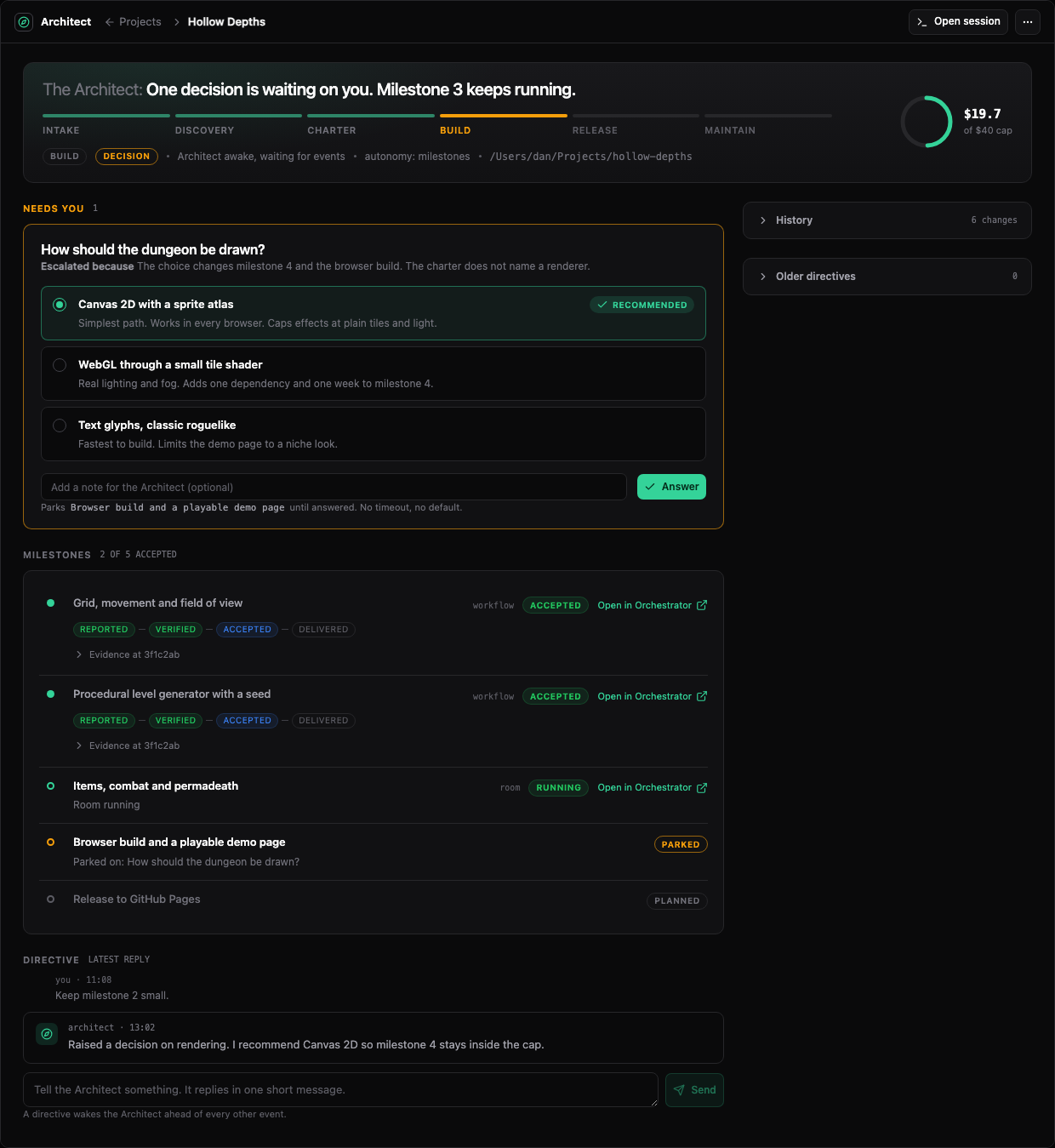
The runtime raises a decision itself, with the proposal attached, when the
owner tries to change an approved charter, deliver to a destination outside
the workspace (email-send, chat-post, webhook-post), or spend over the
remaining cap. The proposal is applied only when you pick apply.
Delivery
A release milestone names a destination. Inside the workspace: pr,
workspace-files, saved-artifact, email-draft. Outside it, always a
decision first: email-send, chat-post, webhook-post. A delivery receipt
is recorded on the milestone; it never substitutes for verification.
Maintenance
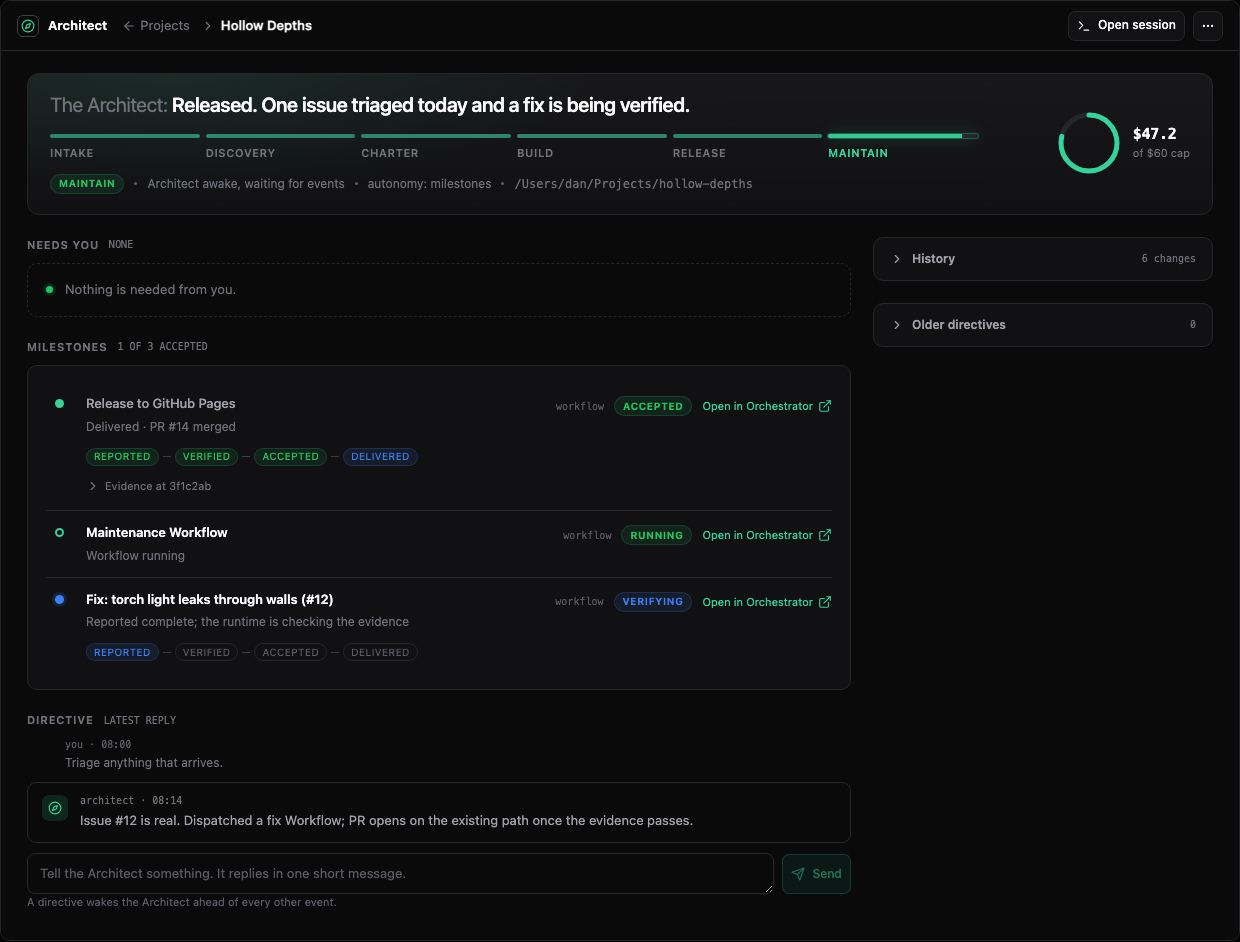
On entering maintain, the runtime creates one Workflow subscribed to
github:issue-opened, github:ci-failed and the schedule 0 8 * * 1
(Mondays at 08:00 UTC). Each run wakes the owner to triage. A fix is a
milestone and moves through the same four verification states.
Runs and telemetry
A project groups its work by objective. One objective has one run, so the run inspector can show what an answer cost without mixing it with the next one. Several objectives can be in flight at once.
Each charge is written to the run journal as the same delta the budget takes, so a run's total and the project spend for the same scope reconcile. A replay of a cumulative report adds nothing.
Coverage is never smoothed. A source that reported no tokens, a run that predates run identity, or a restart that lost part of its telemetry all report as incomplete. Counters nobody reported stay absent rather than showing zero, and an older record keeps the amount it recorded without inventing the calls behind it.
State and storage
The UI, widget and management tool read the index and project record. Open session also reads persistent owner-session history. Layout preferences persist through the host layout service, never through browser storage.